

Starting padel is one of the most exciting sporting journeys you can take. The first time you step onto the glass-walled court, every rally feels electric, the atmosphere is buzzing, and you just know you’re hooked. But here’s where things get tricky: that excitement can quickly become stressful the moment you start looking at rackets.
Suddenly, you’re faced with dozens of models, technical jargon like “18K Alum,” “Multi-EVA,” and “Linear Smart Holes,” and plenty of conflicting advice. The more research you do, the more confused you become. This often results in “The Beginner’s Regret”—buying a professional-grade racket that actually hinders your progress and, in many cases, leads to injury.
Based on hundreds of forum discussions, veteran player interviews, and 2026 gear trends, we have broken down the three most common beginner traps into this comprehensive guide. By the end, you’ll have the “Technical Compass” needed to navigate any pro shop with confidence.
1. The Shape Trap: Chasing “Pro Power” Over Technical Forgiveness
If you’re like 90% of new players, you’re drawn to the aggressive, diamond-shaped rackets made famous by world champions like Arturo Coello or Juan Lebrón. They look sleek, they promise “limitless power,” and they are marketed as the pinnacle of the sport.
Stop right there. This is the single biggest mistake a new padel player can make. The core secret that experienced players wish they understood earlier is this: In your first year, control and comfort are 100 times more valuable than raw power. Your first racket should accelerate your learning curve, not punish your mistakes.
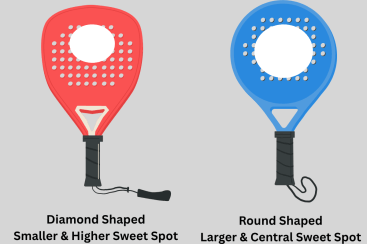
The Technical Reality of Shapes
To understand the trap, you have to understand how geometry affects the “Sweet Spot” and “Balance.”
- Diamond Shape: These have a high balance point (weight focused at the tip). The sweet spot is tiny and located near the top of the frame. As a beginner, your contact point is naturally inconsistent. Hitting even 2cm outside that high sweet spot results in a “dead” vibration and a shot that barely reaches the net.
- Teardrop (Hybrid) Shape: A middle ground. While versatile, many teardrop rackets in 2026 still lean toward a “medium-high” balance that can feel cumbersome for a true novice.
- Round Shape: The “Consensus Choice.” Round rackets are designed for “Control.” The weight is centered toward the handle (low balance), and the sweet spot is massive and centrally located. (For a more detailed look at why round rackets are widely considered the best option for beginners check out our in-depth Round Padel Racket Guide)
The “Forgiveness” Factor
In padel, “Forgiveness” refers to how well the racket handles an off-center hit. A round racket allows you to strike the ball slightly off-center and still generate a predictable, deep shot. This builds the muscle memory required to eventually move to more advanced shapes.
The Bottom Line: Stick with a round, low-balance racket for your first 6 to 12 months. It will speed up your technical development faster than any “power” racket ever could. For a comprehensive guide to the advantages of choosing a round padel racket check out our guide “The Ultimate Guide to the Round Padel Racket: Why Forgiveness Wins”.
🎾 Check out our latest rankings: The 7 Best Round Padel Rackets Under $150 (2026 Edition)

2. The Stiffness Trap: Hard Materials and the “Padel Elbow” Myth
Once you choose a shape, you face the “Materials Wall.” In 2026, manufacturers use terms like 3K, 12K, and 18K Carbon to denote the density of the racket face.
The Mistake: Thinking “Premium” Means “Better for Me”
Many players assume that an 18K Carbon racket—being the most expensive—is the “best” quality. In reality, “K” counts refer to stiffness. 18K carbon is incredibly rigid.
- Low Ball Output: Hard rackets require the player to swing very fast to “activate” the core. Beginners usually have shorter, slower swings. On a stiff racket, the ball simply “thuds” and dies.
- The Vibration Penalty: Stiff rackets do not absorb shock; they transmit it. This vibration travels through the frame and into your tendons, significantly increasing the risk of Epicondylitis (Padel Elbow).

The 2026 Correction: Embrace Fiberglass and Soft EVA
For your first racket, you want a “Soft” touch. This comes from two components:
- Fiberglass Face: Unlike carbon, fiberglass is elastic. It stretches upon impact, providing a “trampoline effect” (High Ball Output). This helps you get depth on your lobs and defensive shots with minimal effort.
- Soft EVA / Foam Core: The internal “rubber” should be soft. Look for keywords like “Soft Performance,” “Ultra Soft,” or “Foam.”
Note for Transitioning Players (Tennis & Squash)
If you are coming from a high-level tennis background, you may find full fiberglass too mushy. Your swing speed is already high. In this case, look for a 3K Carbon or a Carbon-Fiberglass Hybrid face. This provides a touch of the “crisp” feel you are used to without the unforgiving stiffness of pro-level gear.
3. The Weight & Balance Factor: The Silent Performance Killer
Weight is the most misunderstood metric in padel. Most adult rackets weigh between 345g and 390g. While 40 grams sounds like nothing, in the middle of a 2-hour match, it is the difference between a crisp volley and a shoulder injury.
The Mistake: Overcompensating with Mass
New players often choose heavy rackets (375g+) thinking it will give them more “heft” in their shots. However, a heavy racket is much harder to “reset” at the net. If your racket is too heavy, you will find yourself “late” on every volley, leading to poor contact and frustration.
The 2026 Weight Guidelines
- Complete Beginner (Men): 355g – 365g. This is the “Sweet Spot” for maneuverability.
- Complete Beginner (Women): 340g – 355g. Focus on “Light” or “Ultra-light” models to protect the wrist.
- The “Head-Heavy” Danger: Even a light racket can feel heavy if the balance is high. Always check the Balance Point. A “Low Balance” (260mm or less) is what you need.
Customizing with Overgrips
Most factory grips are too thin for the average hand. A grip that is too small forces you to squeeze the handle too tightly, which leads to forearm fatigue.

- The Rule of Thumb: When holding the racket, you should be able to fit the index finger of your other hand comfortably in the gap between your fingertips and the base of your thumb.
- Pro Strategy: Adding 2 overgrips adds about 10g of weight to the handle. This actually lowers the balance point of the racket, making a “medium balance” racket feel like a “low balance” control racket.
Check out our guide to the Best Padel Overgrips currently on the market for a detailed comparison of the best options available right now.
4. Strategic Buying: How to Save Money in 2026
The padel market is flooded with new “annual” releases. Here is how the veterans buy their gear without overspending.
The “Model Year” Hack
Racket technology does not move as fast as marketing suggests. The difference between a 2025 model and a 2026 model is often just a new paint job and a $100 price hike.
- Action: Look for “New Old Stock.” Buying the previous year’s version of a top-tier beginner racket (like the Adidas Drive or Head Evo) can save you 50% without sacrificing a single ounce of performance.
The “Coach Over Carbon” Rule
If your total budget is $300, do not spend $250 on a racket and $50 on balls.
- The Better Move: Spend $120 on a high-quality fiberglass round racket and $180 on a 5-pack of coaching sessions. A coach will teach you how to use the glass and how to position your body. Once your technique is sound, the “beginner” racket will feel like a weapon. A pro-level racket will never fix a technical flaw; it will only highlight it.
- The Best Move: Check out our 3 great value beginner padel padel racket guides to find your great value racket and then look for your coaching lessons:

The “Demo” Imperative
Whenever possible, try before you buy. Most padel clubs in 2026 have “Test Rackets” available for a small fee.
- How to Test: Don’t just smash. Hit 10 lobs, 10 volleys, and 10 slow shots off the back glass. The “right” racket is the one that makes these basic shots feel effortless, not the one that hits the hardest smash once every ten tries.
Summary: Your “Ideal First Racket” Profile
When you go to buy, look for these four “F.A.C.T.” features:
- F – Forgiveness: Round shape with a centered sweet spot.
- A – Arm Safety: Soft EVA core and fiberglass face to dampen vibrations.
- C – Control: Low balance (weight in the handle) for quick reactions.
- T – Tested Weight: Between 350g and 365g for men; 340g and 355g for women.
By avoiding the traps of “Pro Hype” and “Stiff Carbon,” you ensure your first year of padel is defined by progress and fun, not by icing your elbow and regretting an expensive purchase.
So there you have it the most common traps beginners fall into when purchasing their first racket. Hopefully this guide will help you to identify and avoid some of these common traps and make purchasing your first padel racket the exciting and joyful experience it should be without any buyers remorse or regret afterward. Be sure to check out our Padel Racket Hub for many more educational resources on padel rackets for beginners, plus all the latest and most comprehensive padel racket buying and comparison guides. Happy racket hunting along your padel journey.


